
Give Us A Call:
1-855-25-SHEDS
or Contact Us
Converting a Shed Into a Home Gym: Cost & Setup
Learn what it costs to convert a shed into a home gym, including equipment, insulation, flooring, and electrical upgrades. Practical guide for homeowners.
Table of Contents
- Converting a Shed Into a Home Gym: What You’ll Actually Spend
- Breaking Down the Shed Home Gym Cost
- Choosing the Best Shed Size for a Home Gym
- Shed Gym Insulation: Keeping Your Space Comfortable
- Home Gym Shed Flooring Options
- Permits, Placement, and Planning
- Making Your Shed Gym Project Work
- Frequently Asked Questions
Last Updated: October 12, 2026
Converting a Shed Into a Home Gym: What You’ll Actually Spend
Converting a shed into a home gym cost is one of the most practical ways to build workout space at home. You already have a structure on your property. The real question is what it takes to make it functional for exercise.
We’ve helped many homeowners in Summerville and across the Lowcountry think through this project. The total investment depends on what you start with and what features matter most to your training.
Let’s break down the real expenses you’ll face.
Breaking Down the Shed Home Gym Cost
Converting a shed into a home gym cost involves several layers of spending. Some are fixed. Others depend on your choices.
The Shed Itself
You have two main paths here: start with an existing shed or build new.
If you already own a shed, your baseline cost is zero for the structure itself. You’re working with what’s on your property.
If you need a new shed, you’ll choose between:
- Prebuilt sheds – delivered and set up on your site
- Site-built sheds – constructed on-site by a general contractor
- Custom or modular options – sized and configured to your needs
At Cool Sheds, we carry new, used, and custom storage sheds that can serve as gym foundations. A standard 10-by-12 or 12-by-16 prebuilt shed gives you solid square footage for equipment. We handle delivery and professional setup within our service area, so your shed arrives level and secure without third-party haulers.
The choice of shed affects everything downstream. A larger footprint costs more upfront but gives you room to grow your equipment collection without feeling cramped.
Foundation and Site Prep
Your shed needs a solid, level base. This matters for equipment safety and building longevity.
Options include:
- Gravel or crushed stone – simplest, lowest cost, requires raking and maintenance
- Concrete pad – more durable, better for heavy equipment, prevents moisture issues
- Treated lumber skids – middle ground, portable, still allows air circulation
A concrete foundation is ideal for a gym. It handles dropped weights, stays level, and keeps moisture out. Site preparation, clearing debris, leveling ground, removing vegetation, comes before any foundation work.
This is where you confirm what’s included with your shed purchase versus what you’ll arrange separately. When you visit our Summerville sales center, we can assess your property and discuss what makes sense for your specific location and equipment plans.
Electrical and Ventilation
A gym needs light and air movement.
Electrical work typically includes:
- Running power from your home or panel to the shed
- Installing outlets for fans, lighting, or equipment chargers
- Adding a dedicated circuit if you plan heavier loads
Electrical work requires a licensed electrician.
Ventilation keeps the space usable in warm months. Options are:
- Window fans (cheapest, least effective)
- Wall-mounted exhaust fans (moderate cost, real impact)
- HVAC mini-split systems (highest cost, full climate control)
In the Lowcountry’s humid summers, ventilation isn’t optional. Stagnant air makes the space uncomfortable and can damage equipment.
Equipment and Finishing
This is where your gym actually becomes a gym.
Flooring protects the shed floor and your equipment. Rubber mats, interlocking foam tiles, or vinyl roll-out flooring all work. Thicker mats cost more but absorb impact better.
Equipment ranges from basic to extensive:
- Dumbbells, kettlebells, resistance bands
- Workout bench, pull-up bar, squat rack
- Cardio machines (treadmill, bike, rower)
- Mirrors, sound system, storage racks
You control this budget entirely. Start minimal or go full-featured.
Finishing touches might include:
- Shelving and storage
- Lighting upgrades beyond basic fixtures
- Paint or flooring that feels intentional
- Climate control refinements
The equipment and finishing phase is where most homeowners find flexibility. You can start lean and add over time.
Choosing the Best Shed Size for a Home Gym
The best shed size for a home gym depends on your equipment and training style.
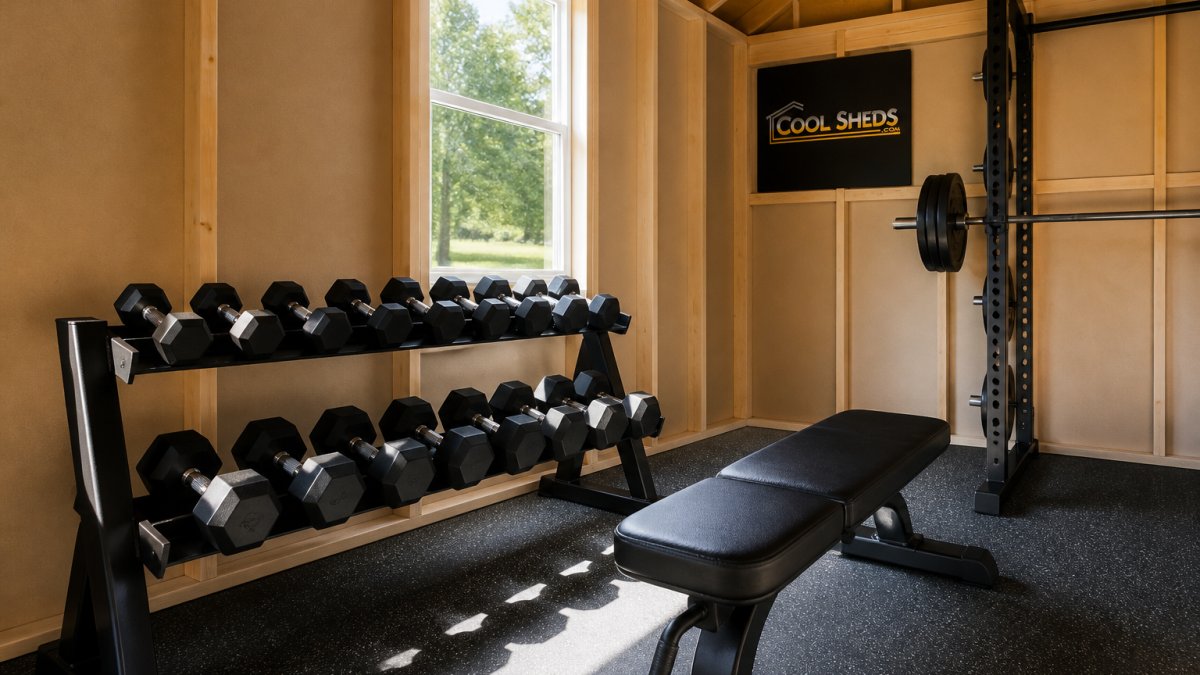
A 10-by-12 shed gives you 120 square feet. That’s enough for:
- Dumbbells and kettlebells on a rack
- A bench and a small cardio piece
- Basic movement space
A 12-by-16 shed offers 192 square feet. This handles:
- A full dumbbell set
- Multiple equipment stations
- Dedicated cardio and strength zones
- Room to move freely
A 12-by-20 or larger gives you space for everything plus storage overflow and comfort.
Consider your actual training. If you’re doing kettlebell swings and burpees, you need open floor space. If you’re lifting heavy, you want room for a squat rack and safety. If you use machines, vertical space matters less than floor footprint.
Many people underestimate the space they’ll need. What feels spacious in a showroom feels cramped once you add equipment and actually move around. We recommend visiting our Summerville sales center to see real shed sizes and visualize your setup.
Shed Gym Insulation: Keeping Your Space Comfortable
Insulation makes your shed gym usable year-round.
The Lowcountry’s heat and humidity are real factors. Uninsulated sheds become ovens in summer and damp in winter. Both hurt your willingness to train.
Insulation options:
- Fiberglass batts – affordable, standard in new sheds, moderate R-value
- Spray foam – seals gaps, higher R-value, more cost
- Rigid foam boards – efficient, works in tight spaces
- Reflective barriers – helps with heat, less effective alone
Pair insulation with ventilation and you’ve got real climate control. Insulation alone won’t cool a shed. It slows heat loss and gain, but you still need air movement and ideally some cooling.
Ask whether your shed comes pre-insulated or if you’re adding it after delivery. Pre-insulated sheds cost more but save labor. Adding insulation later is messier and more involved.
Home Gym Shed Flooring Options
Flooring protects your shed floor and your joints.
Concrete under your shed prevents moisture. On top, you layer:
- Rubber mats – durable, absorbs impact, easy to clean, good for heavy equipment
- Interlocking foam tiles – budget-friendly, softer underfoot, less durable
- Vinyl roll flooring – smooth, easy to install, moderate impact absorption
- Bare concrete – cheapest, hard on joints, slippery when wet
Rubber mats are the gym standard. They last, handle dropped weights, and feel professional. Thicker mats (3/4 inch or more) cost more but protect better.
Flooring ties to your foundation choice. If you’re on gravel or skids, moisture wicks up. A concrete pad isolates the shed floor and lets you use nicer flooring without rot risk.
Permits, Placement, and Planning
Before you build or convert, check local requirements.
Permit rules vary by jurisdiction. Some areas require permits for sheds over a certain size. Others focus on setbacks from property lines or height limits. In Summerville and surrounding areas, HOA rules often matter more than municipal codes.
For prebuilt sheds, we help you complete the permit application package for you to submit to your local authority. For site-built sheds and steel structures, obtaining the necessary permits is typically handled by a general contractor.
Placement matters:
- Setbacks from property lines (typically 5-10 feet, varies by code)
- Distance from utilities (electric, gas, water lines)
- Drainage patterns (avoid low spots that collect water)
- Sun exposure (affects interior temperature)
- Access for delivery and future removal
An on-site consultation helps you identify the best location. We assess building type, size, placement, and delivery access to make sure your shed can actually get to your property and sit where you want it.
HOA approval is separate from municipal permits. If you’re in an HOA neighborhood, we help you select designs that typically get approved and prepare your submission. The HOA makes the final decision based on their rules.
Making Your Shed Gym Project Work
Converting a shed into a home gym cost is manageable when you plan clearly.
Start by answering these questions:
- Do you have a shed already, or are you building new?
- What equipment do you actually need?
- How much climate control matters to you?
- What’s your timeline?
- Are permits or HOA approval required?
The cheapest path is converting an existing shed with basic ventilation and rubber flooring. The most complete path adds insulation, electrical work, climate control, and professional finishing.
Most homeowners fall somewhere in the middle. They invest in a solid foundation, good ventilation, adequate lighting, and flooring that protects equipment. They add equipment gradually and upgrade features over time.
Ready to start? We can help you choose the right shed for your gym and plan the conversion. Visit our Summerville sales center at 1749 N Main Street to see shed sizes in person, or contact us for a consultation. We’ll assess your property, discuss your goals, and help you understand what converting a shed into a home gym cost looks like for your specific situation. We deliver statewide and handle professional setup, so your shed arrives level and ready for the next phase.
Frequently Asked Questions
How much does it cost to convert a shed into a home gym?
The total cost depends on the shed size, condition, and upgrades you choose. You’ll need to budget for the shed itself, foundation work, electrical and ventilation improvements, insulation, flooring, and equipment. Costs vary significantly based on whether you start with a new prebuilt shed or a used one, and how much customization you want. Contact us for a consultation to get a realistic estimate for your specific situation.
What size shed do I need for a home gym?
A 10×12-foot shed works well for basic cardio and free weights. If you want space for a treadmill, weights, and functional training, consider 12×16 feet or larger. Think about your equipment list first, then add 20% extra for movement and comfort. We can help you assess your needs during an on-site consultation at our Summerville sales center.
Does a shed need insulation to be used as a gym?
Insulation isn’t mandatory, but it makes a real difference in comfort and equipment longevity. In the Lowcountry heat and humidity, insulation helps regulate temperature and reduces moisture that can damage equipment and create mold. Proper ventilation is equally important. Together, they create a space where you’ll actually want to work out year-round.
What’s the best flooring for a shed home gym?
Rubber or foam mats are popular because they absorb impact, reduce noise, and protect equipment. Concrete with a sealed epoxy coating is durable and easy to clean. Assess your specific needs and climate conditions before choosing.
Do I need a permit to convert a shed into a gym in Summerville?
Permit requirements depend on your shed size, construction type, and local zoning rules. For prebuilt sheds, we help you complete the permit application package to submit to your local authority. If you’re planning a site-built or steel structure, obtaining the necessary permits is typically handled by a general contractor. Rules vary by jurisdiction, so check with your local building department or HOA first.